BetterAIstartsbeforethemodel.
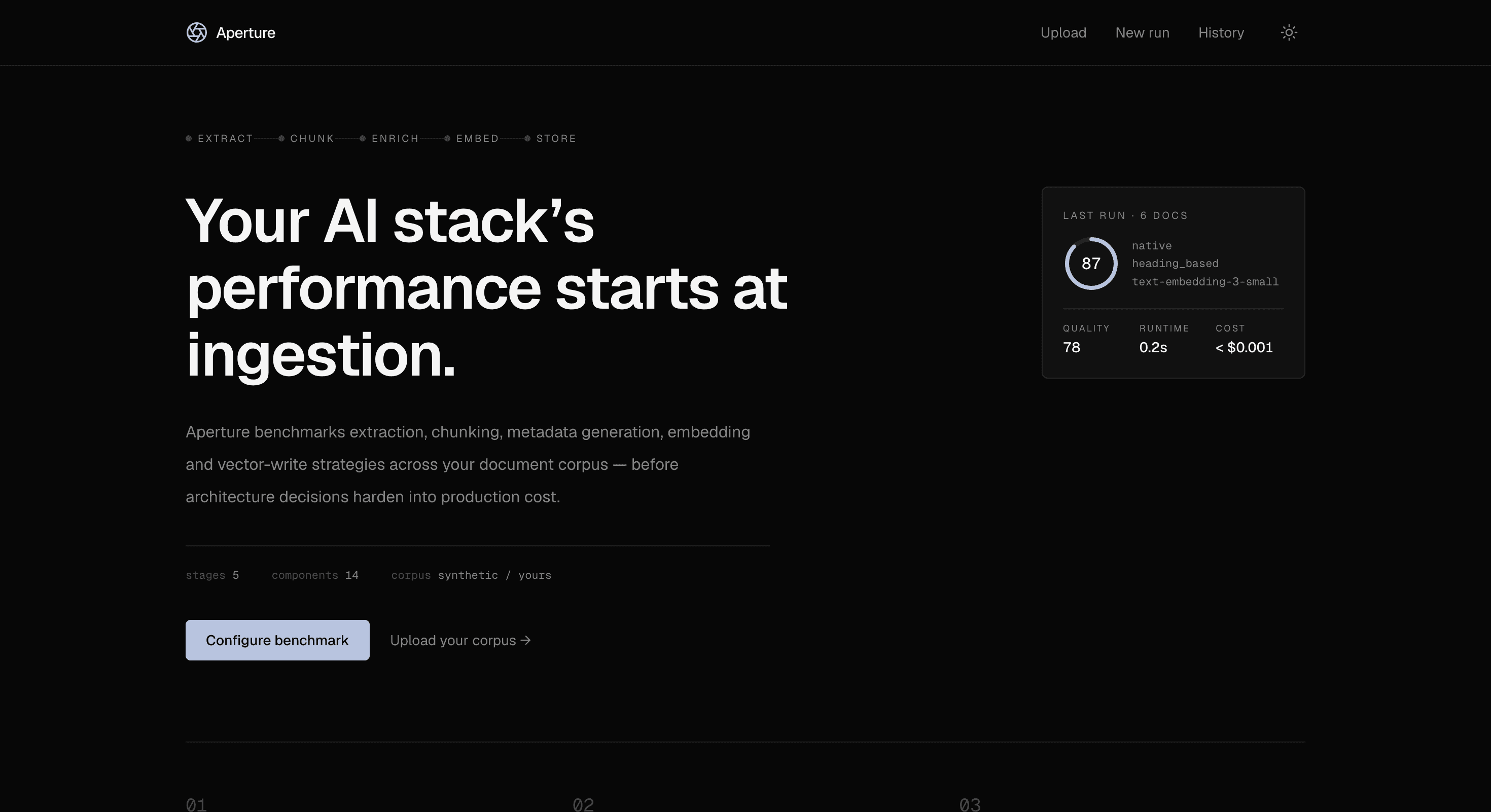
Aperture benchmarks AI ingestion pipelines — extraction, chunking, embedding — on evidence instead of vendor demos.
02 · The problem
Everyone benchmarks the model. Almost no one benchmarks what reaches it.
Extraction, chunking, and embedding choices quietly set a ceiling on retrieval quality — and most teams pick them by habit or vendor demo, not evidence.
03 · The insight
A model can't retrieve what ingestion already lost.
Errors made at the first stage stay invisible — until they surface as a wrong answer three stages later.
04 · The solution
Five independent stages. One scored recommendation.
Every candidate runs against the same document corpus and is scored against an all-defaults baseline — not every possible combination — so the comparison stays interpretable as the number of options grows.
05 · Product highlights
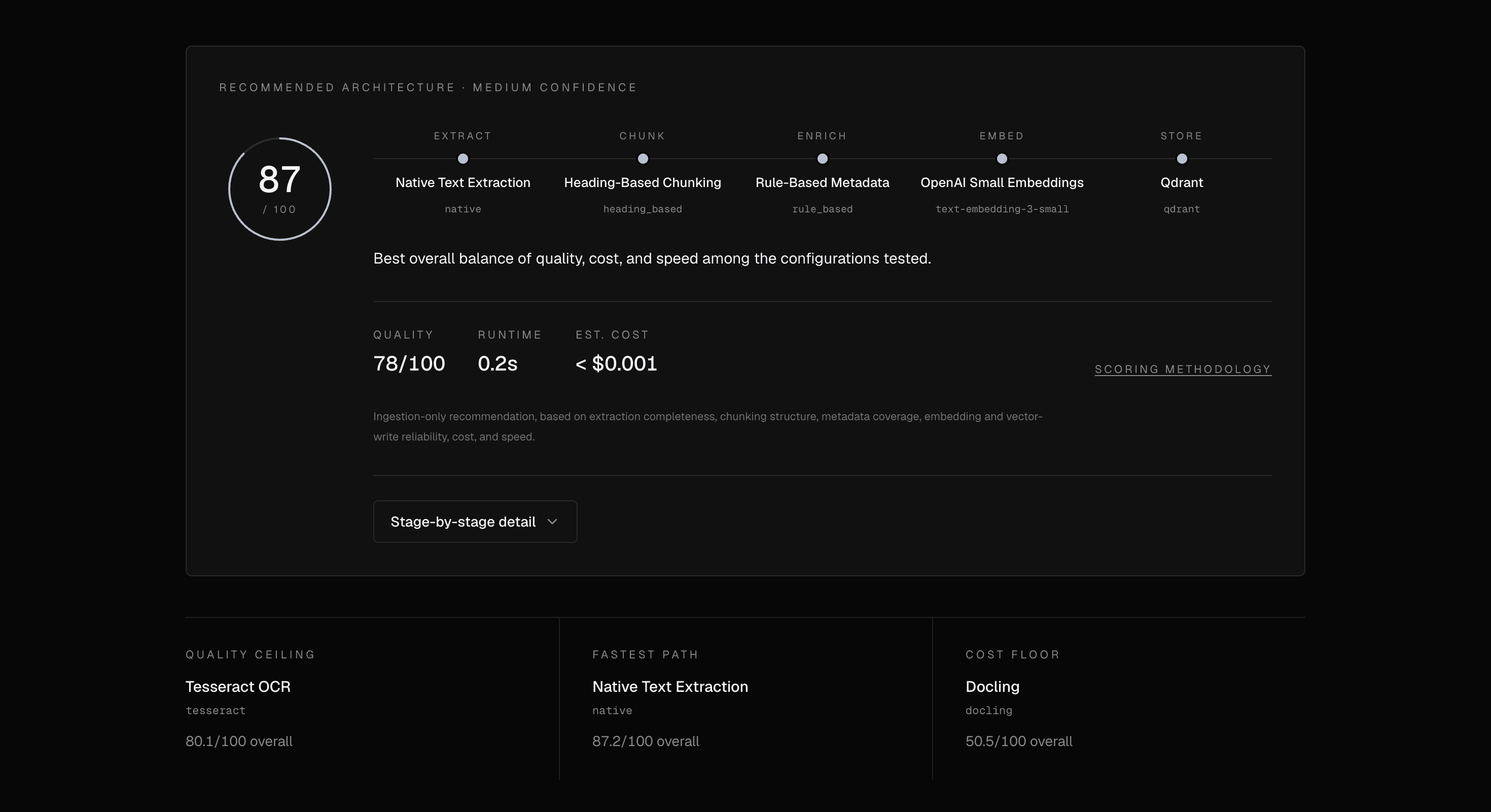
Fig. 01 — The recommendation.
Aperture doesn't just rank configurations — it commits to one, with a confidence score attached, not a spreadsheet to interpret.
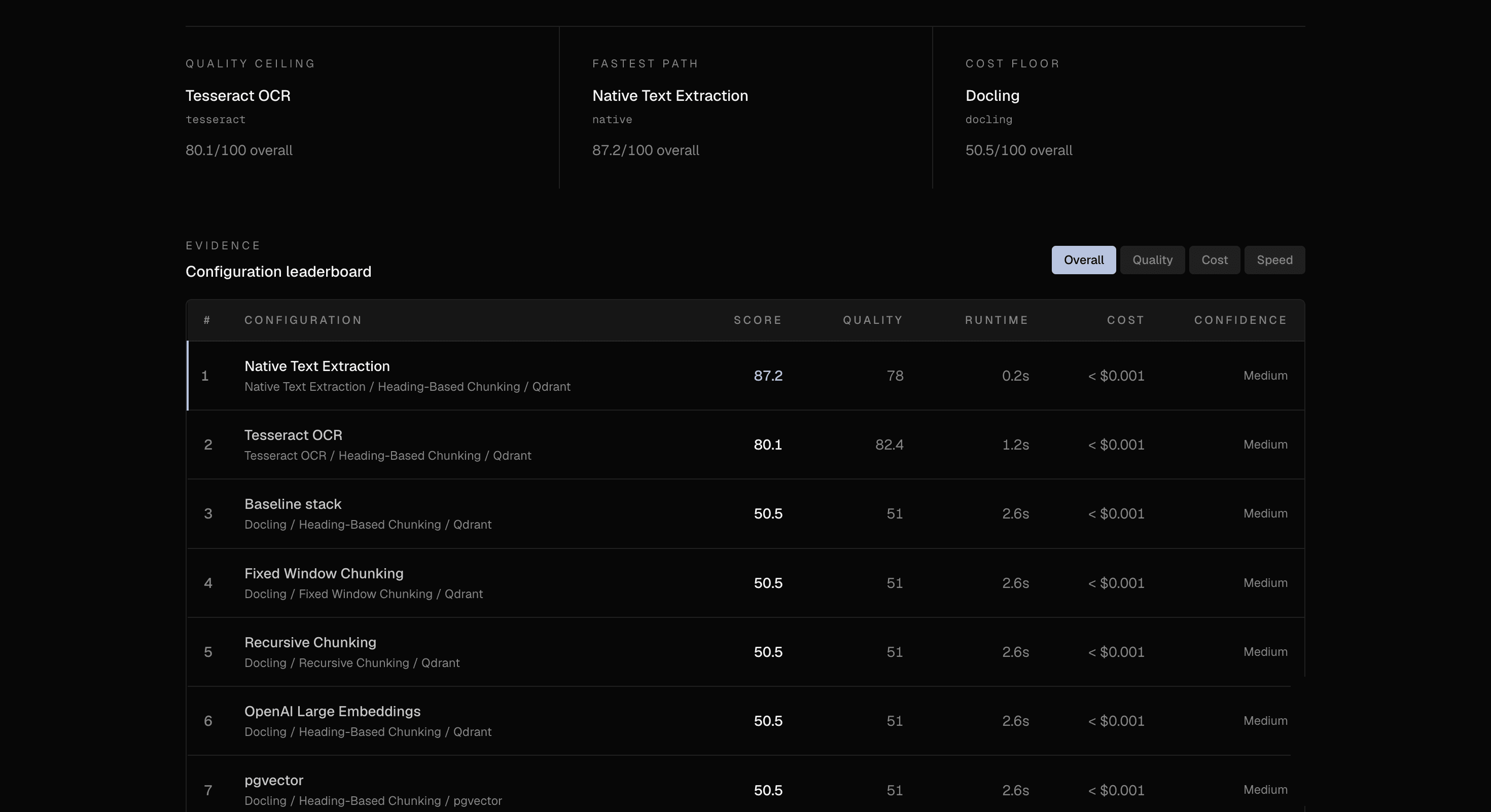
Fig. 02 — The evidence behind it.
Every configuration actually run, ranked on quality, cost, and runtime — nothing fabricated, nothing assumed.
06 · Technical decisions
Decisions that hold up under inspection.
Architecture
Every stage is swappable.
Extraction, chunking, enrichment, embedding, and storage are independent — replace one without rewriting the rest of the pipeline.
Benchmarking methodology
Results stay interpretable as options grow.
Each candidate is scored against an all-defaults baseline, not every possible combination across stages.
Deployment
Built to actually run.
FastAPI on a GCP Compute Engine VM behind Caddy; Next.js frontend on Vercel.
Graceful degradation
Missing credentials don't break a run.
Components without access — Azure Document Intelligence, GPT-4o Vision — drop out as a flagged, excluded result instead of crashing or skewing every score equally.
Scoring model
One score, with its confidence attached.
Quality, cost, and runtime combine into a single number per configuration, alongside a confidence rating on the final recommendation.
07 · Outcome
It's live — and the leaderboard it produces is the evidence most teams skip on their way to picking a model.
Designed, engineered, and deployed solo: product strategy, interface, FastAPI benchmarking backend, scoring methodology, Next.js frontend, and the deploy itself.